
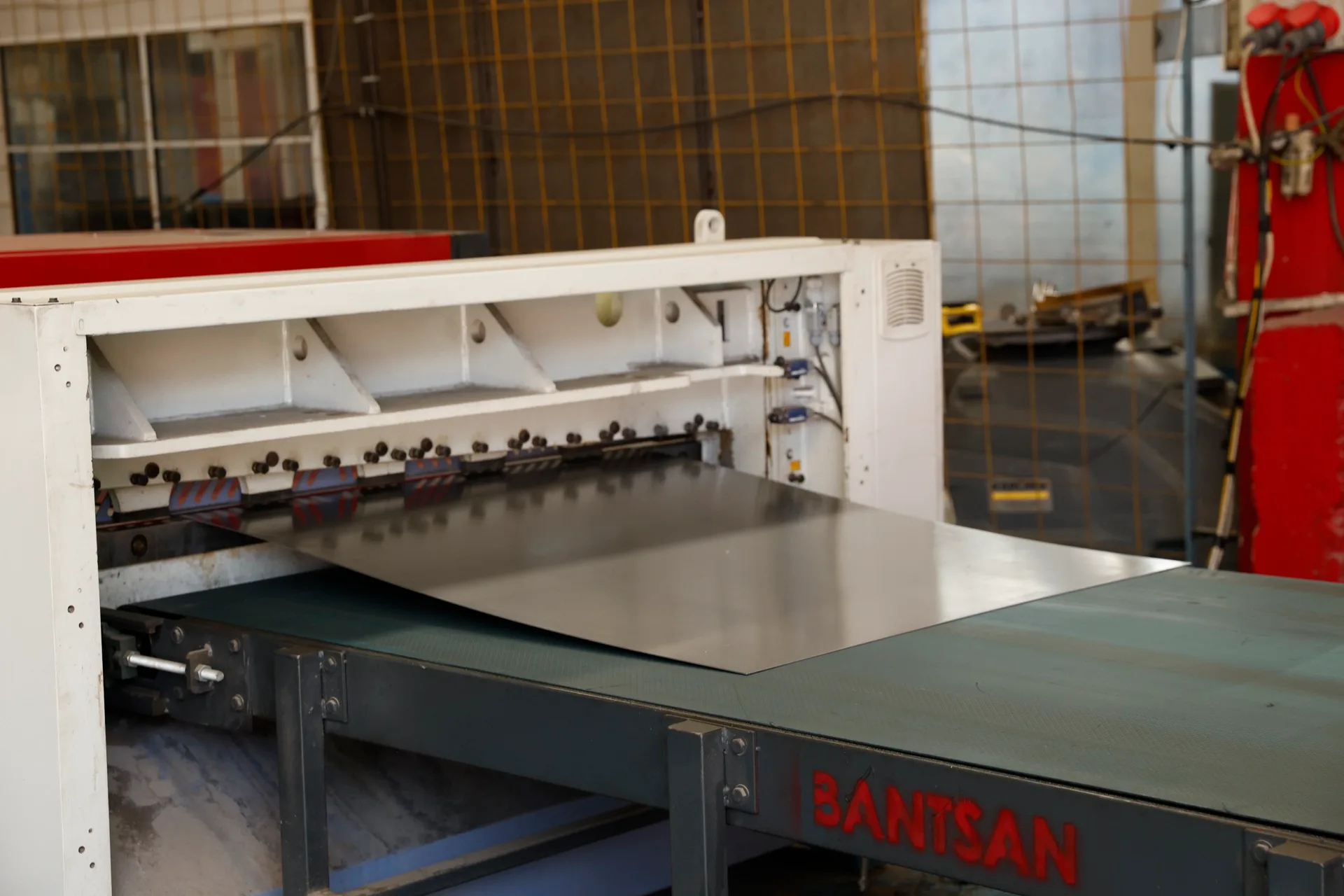
Carbon steel sheet
| Typical use | EN grade | Close US equivalent |
|---|---|---|
| Cold-rolled, general forming | DC01 (EN 10130) | ASTM A1008 CS Type B; SAE 1008/1010 |
| Cold-rolled, deep drawing | DC04 (EN 10130) | ASTM A1008 DDS |
| Hot-rolled, forming | DD11 (EN 10111) | ASTM A1011 CS |
| Structural, general | S235JR (EN 10025-2) | ASTM A36 (similar strength level, not identical) |
| Structural, higher strength | S355J2 (EN 10025-2) | ASTM A572 Grade 50 |
| Hot-dip galvanized | DX51D+Z (EN 10346) | ASTM A653 CS Type B; compare coating weight (e.g. Z275 vs G90) |
Stainless steel sheet and tube
| EN number | EN name | US equivalent |
|---|---|---|
| 1.4301 | X5CrNi18-10 | AISI 304 (UNS S30400) |
| 1.4307 | X2CrNi18-9 | AISI 304L (UNS S30403) |
| 1.4404 | X2CrNiMo17-12-2 | AISI 316L (UNS S31603) |
| 1.4016 | X6Cr17 | AISI 430 (UNS S43000) |
Welded stainless tube for grab rails and handrails is often specified in the US to ASTM A554 (welded stainless mechanical tubing), typically in Type 304. Surface finish (for example a polished grit) should be stated on the drawing.
Aluminum
| EN designation | US (Aluminum Association) | Note |
|---|---|---|
| EN AW-5754 | 5754 | Same alloy designation |
| EN AW-5083 | 5083 | Same alloy designation |
| EN AW-6063 | 6063 | Same alloy designation; common for tube and profile |
| EN AW-6082 | — | 6061 is the closest common US alloy; properties differ |
For aluminum, the temper (for example T5 or T6, H22 or H32) matters as much as the alloy; state both.
What to check before accepting an equivalent
- Minimum yield and tensile strength, and elongation, in the standard each grade is supplied to
- Chemical composition limits, especially for welded parts
- Coating type and weight for galvanized sheet
- Surface quality and finish for visible parts
- Material certificates (for example EN 10204 3.1) and the test methods behind them
The specification on your drawing governs. If a European grade is proposed as a substitute, it should be agreed in writing before production.
Sheet thickness: inches, millimeters and gauge
Gauge numbers mean different thicknesses for steel, galvanized steel, stainless and aluminum, so we recommend stating sheet thickness in inches or millimeters on the drawing. We work with sheet from 0.5 to 20 mm (0.02–0.79 in).