
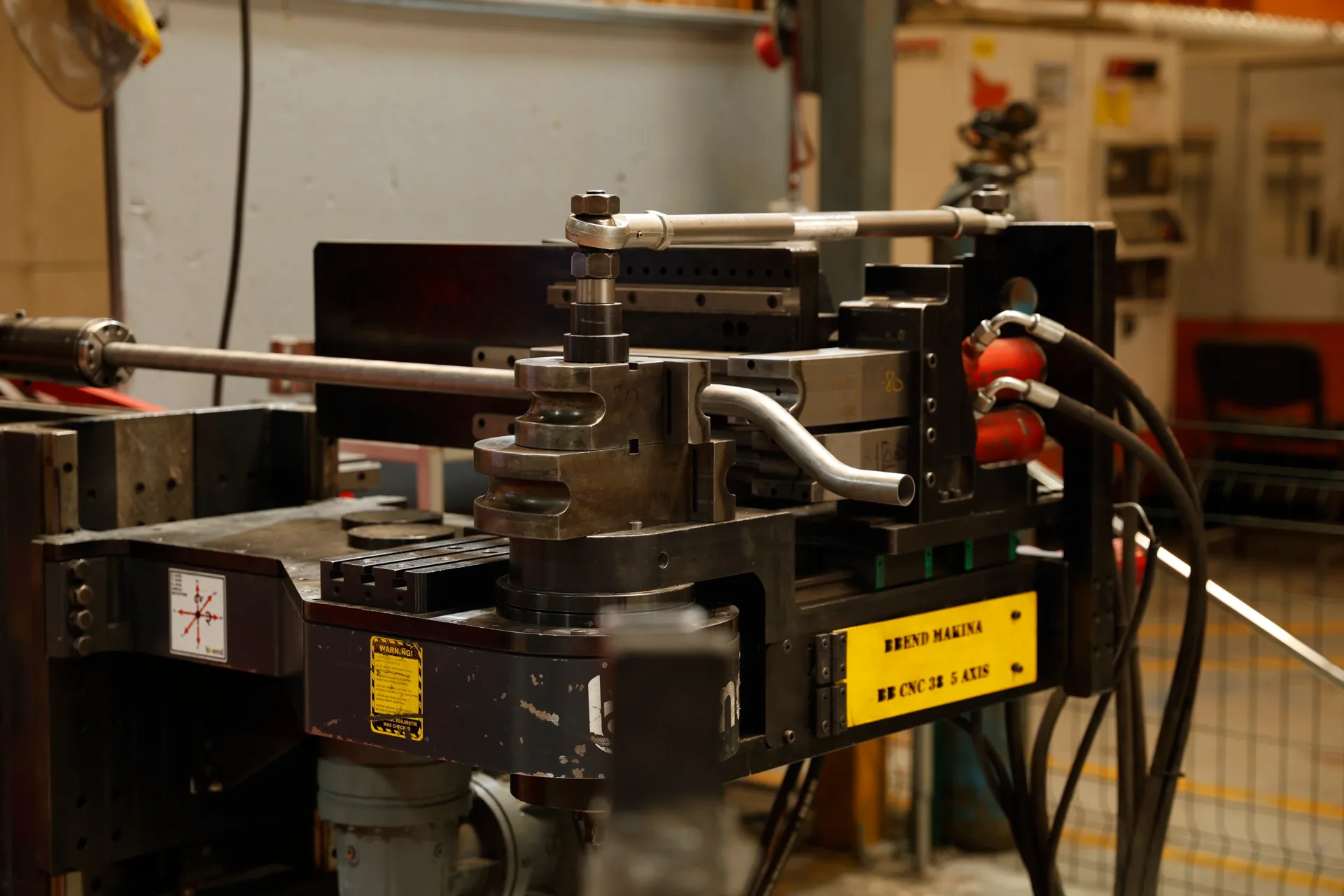
What our line can do
Our tube bending department in Hasanağa OSB, Bursa runs 5 CNC tube benders: three 5-axis, one 3-axis and one NC machine. We bend carbon steel, stainless steel and aluminium tube and profile.
- Tube diameter: up to Ø90 mm
- Wall thickness: up to 5 mm
- Tube length: up to 6 m
- Smallest centreline bend radius (CLR): 10 mm
- Quantities: prototypes, small batches, series production and job bending
These are machine limits. Which combination works for a given part depends on material, diameter and wall thickness together, so we review designs close to the limits with you before quoting.
How to choose the bend radius (CLR)
The CLR (centreline radius) is the bend radius measured on the tube axis. The tighter the radius, the more the outside of the bend thins and the more the inside tends to wrinkle. A generous radius usually means an easier, more stable bend.
Each bend radius needs its own bending die. When every bend on the part has the same radius, the part is bent with one die set and a shorter set-up. If different radii are really needed, our multi-axis machines can bend multi-radius parts, but every extra radius adds tooling cost and set-up time.
The hardest case is a tight radius on a thin-walled tube. Such parts may need internal support during bending; often a slightly larger radius removes the problem altogether.
Think of diameter and wall thickness together
Tubes with a thin wall for their diameter ovalise and wrinkle more easily; thick-walled tubes need more bending force and more careful die selection. Our line bends wall thicknesses up to 5 mm.
On visible parts such as grab rails, surface quality is part of the design: stainless tubes are polished after bending and steel tubes are electrostatically powder coated. All of this happens in the same plant, so the part never travels to another supplier.
Straight length between bends
For every bend, the CNC machine clamps the tube in the die. That needs enough straight length between two bends and at the tube ends. If consecutive bends sit too close together, the part may not be bendable with standard tooling or may need a special die.
Keep holes, slots and welded connections away from bends where you can. We drill after bending on our own line, so holes are not distorted by the bend.
Springback and dimensional checks
A bent tube springs back slightly once the bending force is released. How much depends on material, wall thickness and radius; the CNC program compensates for it, and first parts are measured to correct the program.
We measure bent parts against the CAD model with 3D blue laser scanners (0.02 mm measurement accuracy) and a hand-held, battery-powered CIMCORE INFINITE 2.0 measuring arm. Through series production, the inspection steps of our ISO 9001:2015 certified quality management system apply.
What to send for a quote
- 3D model (STEP preferred)
- Material and grade
- Tube diameter × wall thickness
- Annual volume and batch size
- Secondary operations: drilling, welding, polishing, painting, assembly
More on preparing files in our guide what to send with an RFQ.