
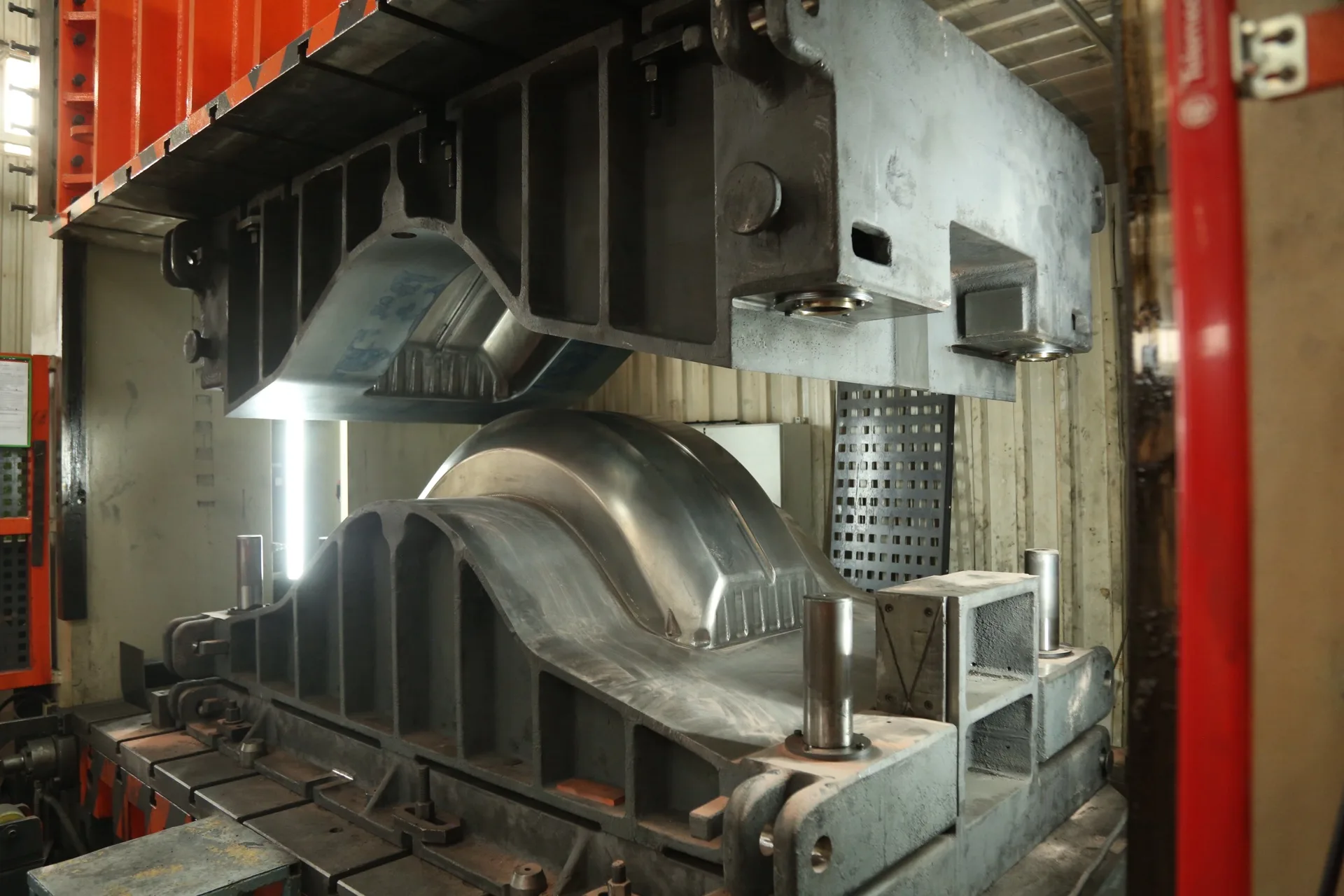
The process step by step
- Quote and feasibility. Manufacturability, material and process route (how many operations, on which press) are assessed from the 3D model and drawing.
- Die design. Dies are designed in CAD/CAM and the forming is simulated, so areas at risk of thinning, splitting or wrinkling show up at this stage.
- Die manufacture. Die components are machined on CNC machining centres and the die is assembled.
- Tryout. The die is tried on the press, first parts are measured and the die is adjusted.
- Samples and measurement. Samples are measured against the CAD model by 3D blue laser scanning and a measuring arm, and measurement reports are prepared.
- Approval. The customer approves the samples and the required documents (for example PPAP).
- Series production. Production starts with the approved die and process parameters; die maintenance is done in our own tool shop.
Example: series production in 12 weeks
We make a tractor fender for an agricultural machinery manufacturer. The part went from quotation to series production in 12 weeks and has been supplied in series for 5 years. The customer is not named for confidentiality reasons.
- Part
- Tractor fender
- Material
- Erdemir 7336 steel sheet, 1.8 mm
- Annual volume
- 5,000 pcs
- Quotation to series production
- 12 weeks
- In supply
- 5 years and ongoing
This is not a lead time we promise for every part; depending on complexity and approval times it can be shorter or longer.
What drives the timing?
- Part complexity and the number of operations (dies) required
- Part size: large parts need large dies and large presses (our press beds go up to 1600 × 2800 mm)
- Material lead time
- Sample approval loops and design changes
- Scope of quality documentation required (for example PPAP level)
Nothing extends the timeline more than a design change after die manufacture has started. That is why we share manufacturability feedback as early as possible, during feasibility.
Before the tooling investment: prototypes
If the part geometry is not final yet, die-less prototypes can be made by laser cutting, bending and welding before investing in press dies. The design is then proven in the real material and the tooling decision rests on data.
Dies and presses under one roof
Our tool shop works in the same plant as our press lines. Corrections during tryout and die maintenance during series production happen without sending the die to another company. Our press park has 7 presses, 4 hydraulic and 3 mechanical; the largest is a 1,200 t hydraulic press.
For a quote
For a die-formed sheet metal part, the 3D model, drawing, material and annual volume are a good start. The full checklist is in our guide what to send with an RFQ.